
Hunter × Hunter Nen × Impact was refused age classification by the Australian Classification Board due to the inclusion of “implied sexual violence” within the game. The game has now been postponed to 2025 and is expected to be released on Nintendo Switch and PlayStation 5.
Although the Australian Classification website did not disclose specific reasons for the refusal, merely stating that further details would need to be obtained through direct contact, the publicly available classification outcome indicates that certain content in the game “exceeded generally accepted community standards,” and even surpassed the thresholds of Australia’s most restrictive classifications, R18+ and X18+.
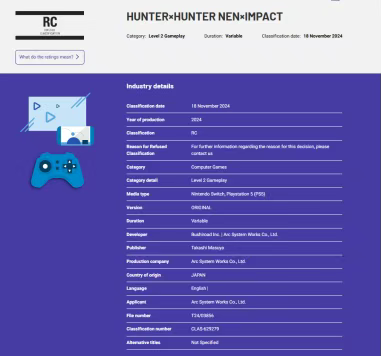 (Image source: Internet)
Subsequently, in a response by the Australian Classification Board to Polygon, it became clear that the primary reason for the refusal was the presence of “visual depictions of implied sexual violence within the game, including scenes in which adult males expose themselves to minors under the age of 18.”
The Board noted in its report that, due to the absence of any resolution to such conduct within the game’s narrative, the implied sexual violence was effectively presented as acceptable behavior, without reasonable contextual justification. The Board’s official statement further stated:
“Implied sexual violence is not permitted to be depicted in a visual manner, to be interactive, to lack reasonable contextual justification, or to be associated with incentives or rewards.”
 (Image source: Internet)
In October of this year, Sony issued an apology to Australian players after Hotline Miami 2: Wrong Number continued to be made available on PlayStation in Australia despite having been refused classification. Although the game had controversially failed to obtain classification from the Australian Classification Board due to themes of sexual violence, it had been available for sale over the past 12 months through PlayStation Plus Extra and the Hotline Miami Collection. Upon becoming aware that the game had not been classified, Sony took measures to remove it and issued refunds to users who had purchased the game during that period.
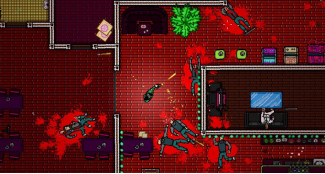 (Image source: Internet)
Australia has long been known for prohibiting games it considers to contain extreme content. In 2012, the Australian Parliament approved the introduction of the R18+ classification, which was applied one year later to Grand Theft Auto V. The primary reasons included the game’s depiction of “high-impact drug use” as well as strong themes, language, sex, violence, and nudity.
Australia maintains relatively strict standards for game classification, and many games have encountered obstacles during the Australian rating process. Last year, Bethesda’s upcoming space role-playing game Starfield received a restricted classification in Australia.
In September this year, Australia updated its classification standards by introducing new policies for video games containing gambling-like elements. These include games featuring “in-game purchases with chance-based elements” (such as loot boxes) and games that simulate gambling activities (such as casino-style gameplay).
Australia’s game classification review process remains stringent. When assessing games, the Australian Classification Board considers factors such as themes, levels of violence, sexual content, language, drug use, and nudity. Game companies planning to release products in the Australian market must therefore exercise heightened caution in evaluating game content to ensure compliance with local classification standards, so as to avoid classification refusal due to content-related issues.
 (图源网络)
 (图源网络)
 (图源网络)